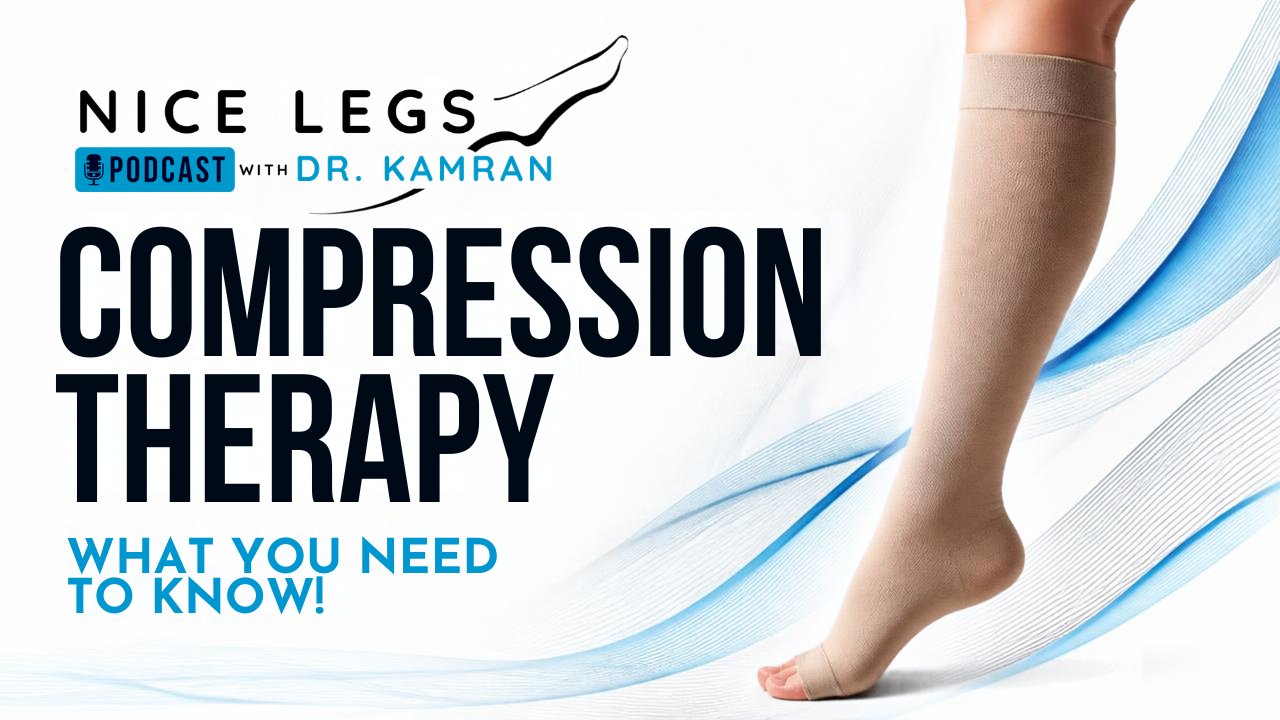
Compression Socks & Stockings: What You Need to Know featuring Glenn Anderson, medi USA
Episode Description
This episode of Nice Legs with Dr. Kamran explores the science and practical application of compression therapy with guest Glenn Anderson, Vice President of Product and Innovation at medi USA and a board member of the US Medical Compression Alliance.
Key Highlights & Takeaways
- What is Gradient Compression? Compression therapy works by applying the highest pressure at the ankle, which then gradually decreases as it moves up the leg. This mimics the body’s natural circulation system, helping push blood from the extremities back to the core.
- FDA Regulation vs. Online Novelty Items: True medical-grade compression stockings are strictly regulated medical devices monitored by the FDA. Products sold cheaply online (often based on shoe size rather than ankle circumference) can be ineffective or even dangerous, sometimes cutting off circulation.
- Choosing the Right Pressure & Fit: Standard pressure ranges typically include 15-20, 20-30, and 30-40 mmHg. Accurate sizing, which is measured in centimeters around the ankle rather than standard shoe sizes, is critical to ensure both comfort and medical efficacy.
- Ambulatory vs. Bed Rest Wear: Hospital anti-embolism stockings are designed for bed rest and lack the structure needed for walking. Everyday medical compression garments are specifically engineered for ambulatory use (moving and walking).
- Donning & Doffing Aids: Putting on compression wear can be tricky at first. Using specialized rubber gloves, wireframe “butlers,” and extended-handle removal tools makes the process significantly easier for patients, especially those with mobility or grip challenges.
- Managing Warmth and Heat: Modern textile technology incorporates advanced fibers that wick moisture away from the skin and allow heat to radiate outward, making compression stockings much more comfortable to wear during warm weather.
Note: Always consult a primary care physician or vascular specialist before starting compression therapy, especially to rule out conditions like peripheral arterial disease (PAD).
About Our Guest: Glenn Anderson is Vice President of Product and Innovation at medi USA and a Board Member of the U.S. Medical Compression Alliance, an industry advocacy organization dedicated to advancing awareness of the benefits and value of medical compression.
With more than 25 years of healthcare leadership experience, Glenn has built his career around advancing patient-centered innovation and improving outcomes through education, access and evidence-based product development.
His work uniquely bridges industry, clinical practice, research, and policy, giving him a broad perspective on the opportunities and challenges shaping medical compression today. Glenn is also actively engaged in the evolving CMS reimbursement landscape, advocating for sustainable access to compression therapies and better outcomes for patients.
Aimee (00:01)
Compression socks and stockings are everywhere. But how do you know what kind of compression you actually need? And what about that $20 pair you found online? Is it doing what it’s supposed to do? In this episode of Nice Legs with Dr. Kamran, we’re taking a closer look at the science.
And the practical side of compression therapy. So from pressure levels and proper fit to the technology behind the garments themselves, how to put them on, and when compression may not be enough. Dr. Kamran is joined by Glenn Anderson. He’s the Vice President of Product and Innovation at medi USA and a board member of the US Medical Compression Alliance, an industry advocacy organization that’s dedicated to advancing awareness of the benefits and value of medical compression.
And with more than 25 years of healthcare leadership and experience, Glenn has built his career around advancing patient-centered innovation and improving outcomes through education, access, and evidence-based product development. His work uniquely bridges those industry and clinical practice insights along with research and policy. And today, together with our host, Dr. Kamran Goudarzi, they’ll shed
insight on what you need to know before choosing
a compression garment. So, Dr. Kamran and Glenn, thanks so much,
of course.
For being here on the nice legs with Doctor Kamran podcast.
Kamran (01:16)
Thank you.
Glenn (01:16)
Pleasure.
Thank you.
Kamran (01:17)
So I’m so glad and so thankful for Glenn and for Medi to allow us to have this interview.
this gives me an opportunity to ask him all the questions that my patients had asked me and some of the questions that I have myself. I hope, Glenn, you’re ready to answer this. But don’t blame me, blame my patients for asking these questions. So full disclosure, we are not getting paid by medi or any other company to do this.
I personally like medi
quite frankly I wear them every day myself. I’ve been very impressed about how long they last. I’m impressed how they feel.
as an advocate for my patients, we
wanted to make sure to bring the product that I like the best to have this discussion and answer these questions. it is probably could call it subjective what but somebody who’s had over twenty five years experience in treating Venus insufficiency I like to consider myself as some form of expert when it comes to this stocking.
with that in mind, Glenn,
if you could kinda tell us a little bit of what the compression stockings are, what they mean.
Glenn (02:22)
Sure. first of all, thanks for having me. it really is a an honor and a pleasure. so compression stockings in the most elemental basis, one of the words that we would have to throw in there would be gradient compression stockings, where the highest pressure exerted into the limb, specifically the leg in this case, is at the ankle, and then the
Pressure gradually decreases as you go up. So it’s basically mimicking the body’s system. And it acts as an aid in improving circulation. Now, as you know, as a physician, when you improve circulation, many things come along for the ride, as we say. oxygenation is improved. in athletes, there’s evidence that it clears the lactic acid or
you know, the fatigue elements in the muscle groups, which is why you might see many professional players wearing them or amateurs or otherwise. but it’s it’s all about assisting the body’s ability to improve blood flow from the extremities back to the core, to the heart and lungs.
Kamran (03:34)
So I always like to in a way, in a simplified way, try to explain to my patients that the deeper you go in the water, the more pressure. It’s a hydrostatic pressure. So when you’re standing, the pressure on your groin is less than it is at your ankle. And in order to you basically reverse it. You put the highest pressure at the ankle and it is a gradual drop towards your groin. Am I correct?
Glenn (03:57)
That that’s exactly it. It it it would mimic as if you were standing in a swimming pool, the peak pressure underwater is going to be at your ankle if you’re standing on the bottom, and then of course the pressure gradually decreases as you get closer to the surface of the water. So that is exactly it. That’s the gradiency aspect of compression.
Kamran (04:18)
So if we would only learn to never stand up straight, we would not need compression stockings
Glenn (04:25)
Gravity
is the enemy at some level. Yes, you’re a hundred percent.
Kamran (04:29)
Okay.
So with that in mind,
in the United States there’s only like three different companies who are FDA approved. So
the reason is not all the stockings are made the same and FDA is very strict. so if you could kindly expand on the importance of FDA and getting the correct stocking.
Glenn (04:51)
Absolutely. so yes, we are regulated by the FDA. I guess the the best equivalency you can think of is things like vitamins or supplements are typically not regulated by the FDA, but medication is. That would be the distinction between many socks that claim to be compression versus true medical devices. The medical device would be regulated by the FDA, and that’s what we
We produce, we have to follow those regulations per the FDA. And that includes the design aspects and the specifications that we develop, the engineering side of things, as well as the daily execution in the manufacturing of products. So when the FDA does come in the door.
They look at all of those aspects of our production process. They look at all of our records and they verify that we aren’t just giving it lip service, that we are in fact delivering products billed to a very concise specification and that they are going to do what they need to do. When does the FDA get involved? If you are going to make claims behind your product about improving blood flow, about preventing the pooling of blood.
You know, et cetera. And we make those claims because we quite frankly produce a quality product that we are comfortable doing and we follow the regulations. unfortunately there are many out there that are not so strict about it. They avoid that claim, yet they still claim it to be compression. So
Kamran (06:24)
I have seen patients come to my office. Twenty five years is a long time. So you name it and I’ve seen it. And they were wearing knee highest stockings that they bought from I don’t know, ten dollars from, you know, one of these places. And they came in and literally where the band was below the knee, they actually got a clot. So they would have been better off not wearing it.
But sometimes those few extra dollars, you know, you spent to get the right product is extremely important.
So people don’t always understand not all socks not all the stockings are the same. And if you are going through FDA and the regulations, there’s some costs involved and that’s why the products are a little bit more expensive. Is that is
that correct?
Glenn (07:04)
Mm-hmm.
Yeah, it it’s definitely a significant element in the expense of the product. There’s no doubt about that. we happen to produce in the US, the vast majority of our stockings, in North Carolina. but the regulations certainly dictate our adherence to the regulations, I should say, is
Very prescriptive. We have to make sure we’re doing what we claim we’re doing. And we obviously ultimately our mission as a company is to help people feel better, is to treat patients how they would like to be treated, how they want to have the positive results. like typically when you’re recommending or prescribing compression stockings to your patients, Dr. Kamran how often are they supposed to wear them? And you know, what do you advise in those situations?
Kamran (07:52)
And of course the every clinical situation is different. For example, if I have somebody who’s got gigantic veins and some of those are really large, to the point that even laser ablation would probably not take care of the those. And they can get trapped blood. So those I ask them to where the compression stockings day and night for a whole week. Somebody’s got the smaller veins, I just tell them during you know, where then during the daytime. So that is really clinical, you know.
Decision obviously, but you want to make sure if we don’t give them the right stocking and they can get leg ulcers.
So compressions are extremely important. You know, where you put them your and and how you huh?
Glenn (08:28)
Exactly. Right. And that and that’s
and that’s it the reason I asked that question of you is because everybody has to be conscious of the economy, so to speak, you know, what they’re spending on things. But at the same time, you know, this is a critical element in their treatment and they need it to be comfortable and effective. If it’s not comfortable, they’re not going to wear it, which means it won’t be effective.
and that’s one of the key elements behind the quality levels that we maintain, not just induced by FDA regulations, but by our own quality policies as well. We wanna live up to those standards that patients are going to be treated well and compliant so that you get the best clinical results and ultimately the patient gets the best clinical results possible from the procedure.
Kamran (09:21)
And with that on that note People believe that all compressions are the same. for example, I think with most veins, we are still trying to come up with a device where we could measure the amount of pressure needed to collapse a vein. And as you know, it could be different for depends how much
adipose tissue you have, how much skin changes you have. But normally I’ve noticed it’s always a compromise.
So in in my practice, I’ve noticed about fifteen to twenty is is usually pretty good. It is the compromise is they c it’s comfortable enough that they can put it on, because if it’s uncomfortable, it doesn’t do any good on the shelf. It’s supposed to be on your body.
And if it hurts you’re not gonna wear it and sometimes you it’s it’s better to do a little than doing nothing at all. the one thing, please correct me if I’m wrong, but I heard quite a while back that one of the patents I believe Medi has is the it it stretches in two directions, whereas the other products I think it’s stretch in one.
This makes it more comfortable to wear it or or not comfortable. And I don’t know if I’m correct about that or not.
Glenn (10:31)
no, this the stretch definitely matters. And I I wouldn’t I wouldn’t wanna I wouldn’t wanna overstretch and say we have a patent per se. you know, this is a very wide open field. It’s been existing for a long, long time. Most patents have long since expired. But the dynamic stretch or multi directional stretch is truly important. As you as you see and and anybody, you walk down the street and you see people have different sized legs.
Some with wider calves, some with narrower calves in relationship to the ankle circumference. so that allows for better conforming, better fit, and ultimately more comfort. so the the dynamic stretch and multi directional stretch as you as you refer to, does matter, especially when it comes to putting the product on and wearing it all day, and then of course removing the product as well.
Kamran (11:23)
So that takes me to two other questions. So number one, how much pressure do you wear?
And then you’ve got to decide does it go to the knee or you does it go to the thigh or to the groin?
So when it comes to the length obviously that is also important.
Kamran (11:36)
But if you would be so kind, can speak a little bit about the different pressures and what you normally have the demand for.
Glenn (11:47)
Sure. the fifteen to twenty, twenty to thirty, and thirty-forty ranges are are typical. what that means though is that that’s going to be the maximum pressure at the ankle. And then it will reduce from there. Or again, gradiency. Okay. So most people are very comfortable in the fifteen to twenty. Like you say, there are always clinical clinical indications you have to be careful of. Twenty to thirty is also very comfortable for most.
I I personally wear twenty to thirty almost every day. Our athletic assortment that we use with long distance runners, et cetera, CEP, is generally in the twenty to thirty range. So it it’s effective, but again, not too much. Thirty to forty is the more extreme case. And the higher the pressure, as you say, Dr. Kamran you have to be cautious of complications
Kamran (12:37)
Thank you so much. Just if I could throw this in, because when I was in at medical school we used to put everybody in those white stockings which
come to find that they were not designed to walk with. So the ones you put in in the hospital you’re supposed to put them on and when you’re at bed rest but when start moving, the the structure of the stocking should be such that it’s designed for walking. And the stockings, for example, that you make, the Medi stockings are really designed to walk and not not to just put them on and and be on bed rest correct?
Glenn (13:09)
That is very correct. the bed the ones you wear in bed are more for DVT prevention, to reduce the chances of having a DVT. but like you say, they’re not for ambulatory use. They are not designed to stay up while you’re walking. So whereas the majority, vast majority of compression stockings that we produce are intended for ambulatory use, or in other words, they’re designed to stay up while walking and and continue to be effective.
Kamran (13:38)
In fact some of the stuff if you see on the on on TikTok, that’s what they’re using. They’re using this stocking which was designed to to wear in the hospital. They just wore it right outside and thinking that that’s what it’s designed for. So it’s important to know the right pressure. what is it designed for? Is it for walking or bed rest?
then of course if you have PAD or peripheral arterial disease, you really shouldn’t be putting a stocking on.
So it’s a good idea to just don’t go and buy one and put it on because you could do more harm than good. Make sure you talk to your primary care physician or somebody who’s familiar with medicine, you know, maybe a vascular surgeon so they can tell you if it is safe for you to wear this stocking.
There are of course different types. I’m glad you mentioned the CEP stocking. That’s really designed for athletics, when you’re running and jogging. So I usually recommend to my patients, you know, wear thigh highs because my most of my patients have chronic venous sufficiency. The disease starts at the groin. so they really want the pressure all the way up. But then once you’ve done the procedure or if they want to go and jog and a lot of our patients are runners, then CEP stockings work very well. In fact they’re designed so at night you can see it, they’re you know
Cool looking and also some of them are reflective so cars can see you as you’re crossing the road, so hopefully don’t run you over, right?
Glenn (14:54)
Yeah
yeah, that that’s preferred, definitely.
Kamran (14:57)
Okay. so the next question I had actually from Aimee if you could I think you had some as as a consumer you had a few questions here.
Aimee (15:10)
Yeah, so so Glenn and Dr. Kamran, you know, from the consumer side, I’ve seen plenty of videos on social media of folks trying to squeeze into compression wear. and I’m sure many can relate to having those either ride up or roll down and, you know, almost kind of cut off circulation, which seems a bit counterproductive to what you’re wearing them for. what’s what’s going on here when when folks are having these issues?
Glenn (15:35)
It it the first experience with compression is always a challenging experience. you know, there’s we can’t make up stories about that. There’s plenty of them online that are quite exaggerated, but a little coaching goes a long way. I the analogy I would use it’s many people out there wear contact lenses, but it is not intuitive to stick your finger in your eye the first time you put contacts on. compression stockings are similar. The first time is not intuitive. It there are
donning instructional videos, there are donning aids. and quite frankly, it it’s not that difficult once you know how to do it. Right.
Aimee (16:14)
Well, Glenn, we’ve actually got a video here that’s on you guys’ YouTube channel. Mind if we play that? Would you guys like to see that?
Glenn (16:21)
That would be great.
Kamran (16:22)
Absolutely,
Aimee (16:23)
Okay.
Kamran (16:23)
yes.
Aimee (16:24)
All right.
And so I’m playing this without the audio. So Glenn, can you tell us w what we’re seeing here?
Glenn (16:29)
Yeah, sure. You want to take that stocking and really turn it inside out up to the heel pocket. So you’re putting it on a little bit at a time. So right now you’re only donning the foot portion. So it makes it easier. we do recommend gloves, especially for our finer fabrics, the more sheer stockings, because it helps you one grip the stocking and not puncture it with a fingernail.
So what you see this patient doing is basically taking it on a little bit at a time and then working it up the leg, but the foot is already in position. And then you use the gloves to just distribute the fabric.
Aimee (17:09)
Okay, fantastic. And so we’ve got another video
So tell us a little bit about what we’re seeing here.
Glenn (17:19)
So a lot of folks struggle a bit when it comes to removing stockings. Okay. So what this does is it allows you to have more reach. As you can see, it’s an extended handle. So you remove the stocking just kind of to the halfway point. All right. And then what you’re doing is just sliding that flat portion down to your heel and then just popping it off your foot.
Aimee (17:47)
Dr. Kamran, do you find your patients using these devices and it being helpful for them?
Kamran (17:52)
absolutely. I I wear my stocking every day and believe it or not, I I use that. the trick there is please don’t be too forceful. once I push so hard that I put a hole through it. But I wasn’t patient. Don’t just start pushing on it until it gets it makes it to your ankle. And it’s very, very easy to use. And of course we have the butler as well. That’s the one they actually put the stocking on. It’s like a frame.
Glenn (18:15)
Yeah, this is a very nice device.
It’s a wireframe that allows you to stretch the stocking prior to putting it on. So you can see here, you put it on the frame up to the heel pocket again, so that you can just slide your foot into that opening. And then you use the handles again as an assist, and it allows you to slide that stocking up your leg and then
What ultimately happens is you put the gloves on and that allows you to distribute the rest of the fabric. it’s a very simplified process. It’s great for patients that struggle with compression and or other mobility or grip issues such as arthritis. And it it’s a very handy aid to make sure that you’re getting the medical compression therapy that you do need.
Kamran (19:10)
Glenn, we are short of time, so I’m gonna ask some questions real fast here. a lot of people in, it is North Carolina, so very warm here and a lot of people are especially this summer, heat is a big problem. So if you could kind of explain the different type of t texture material we have that you know, does does it make makes it a little easier to to tolerate the heat.
Glenn (19:36)
definitely. technology’s come a long way. So textile technology is no different. There are very specialized fibers that are built into many types of the compression that not only we produce, but others that allows that heat to radiate outwards, especially moisture. when you trap moisture against the skin, you’re allowed to wick that moisture outwards and allowing it to evaporate easily.
Kamran (19:58)
patients ask me this all the time. I’m like, okay, you don’t go to a shoe store and just pick up one shoe.
And say this shoe didn’t fit. It was uncomfortable. You’re supposed to get sized. the same thing with the stocking. You need to be sized. It is important to size and wear the right size. And I think that’s one of the problems when you go buy it online. I think there are some issues. because can you answer that? And the final question there would be about people buy they say you know they’re buying whether it’s Juzo or whether or whether it is Medi on Amazon, like
10, 20 dollars. I I didn’t f ever fully understand that. So can you if you could just answer those two questions for us, I would really appreciate that.
Glenn (20:39)
Yeah, sure. Well, sizing is super critical. i the first red flag when buying products online is if they’re selling compression products and making claims about compression, but selling by shoe size, the size of your foot or the length of your shoe is not relevant to the circumference of your ankle. The circumference is what matters. Medi happens to produce sizes that are only two centimeters in increments. that’s less than an inch.
So for every inch of ankle circumference, you go up a size. It makes it easier to put on and it makes it more medically effective. It does lead to more sizes being available, but that measurement is key. you know, and and like I say, you know, when you go online, let’s just say it’s the Wild West of compression. you don’t really know what you’re getting. we we do all of our compet competitors on the
on the premier, know, competitors that are FDA regulated as ourselves, we do sell online, but you have to be careful about what you’re buying and you’re gonna recognize the difference, especially when you see somebody selling by shoe size.
Kamran (21:42)
And that’s one of the biggest problems we have is people buy their own stockings, you know, online and then they come to the office. And quite frankly, some of them I can’t do that procedure because if it doesn’t fit, then the laser we use for ablation you know, is isn’t is not gonna work. Or if it’s too tight I can put that on. So I’m not this sizing is obviously extremely important. I think most people are not aware of that.
Aimee (00:01)
Compression socks and stockings are everywhere. But how do you know what kind of compression you actually need? And what about that $20 pair you found online? Is it doing what it’s supposed to do? In this episode of Nice Legs with Dr. Kamran, we’re taking a closer look at the science.
And the practical side of compression therapy. So from pressure levels and proper fit to the technology behind the garments themselves, how to put them on, and when compression may not be enough. Dr. Kamran is joined by Glenn Anderson. He’s the Vice President of Product and Innovation at Medi USA and a board member of the US Medical Compression Alliance, an industry advocacy organization that’s dedicated to advancing awareness of the benefits and value of medical compression.
And with more than 25 years of healthcare leadership and experience, Glenn has built his career around advancing patient-centered innovation and improving outcomes through education, access, and evidence-based product development. His work uniquely bridges those industry and clinical practice insights along with research and policy. And today, together with our host, Dr. Kamran Goudarzi, they’ll shed
insight on what you need to know before choosing
a compression garment. So, Dr. Kamran and Glenn, thanks so much,
of course.
For being here on the nice legs with Doctor Kamran podcast.
Kamran (01:16)
Thank you.
Glenn (01:16)
Pleasure.
Thank you.
Kamran (01:17)
So I’m so glad and so thankful for Glenn and for Medi to allow us to have this interview.
this gives me an opportunity to ask him all the questions that my patients had asked me and some of the questions that I have myself. I hope, Glenn, you’re ready to answer this. But don’t blame me, blame my patients for asking these questions. So full disclosure, we are not getting paid by Medi or any other company to do this.
I personally like medi
quite frankly I wear them every day myself. I’ve been very impressed about how long they last. I’m impressed how they feel.
as an advocate for my patients, we
wanted to make sure to bring the product that I like the best to have this discussion and answer these questions. it is probably could call it subjective what but somebody who’s had over twenty five years experience in treating Venus insufficiency I like to consider myself as some form of expert when it comes to this stocking.
with that in mind, Glenn,
if you could kinda tell us a little bit of what the compression stockings are, what they mean.
Glenn (02:22)
Sure. first of all, thanks for having me. it really is a an honor and a pleasure. so compression stockings in the most elemental basis, one of the words that we would have to throw in there would be gradient compression stockings, where the highest pressure exerted into the limb, specifically the leg in this case, is at the ankle, and then the
Pressure gradually decreases as you go up. So it’s basically mimicking the body’s system. And it acts as an aid in improving circulation. Now, as you know, as a physician, when you improve circulation, many things come along for the ride, as we say. oxygenation is improved. in athletes, there’s evidence that it clears the lactic acid or
you know, the fatigue elements in the muscle groups, which is why you might see many professional players wearing them or amateurs or otherwise. but it’s it’s all about assisting the body’s ability to improve blood flow from the extremities back to the core, to the heart and lungs.
Kamran (03:34)
So I always like to in a way, in a simplified way, try to explain to my patients that the deeper you go in the water, the more pressure. It’s a hydrostatic pressure. So when you’re standing, the pressure on your groin is less than it is at your ankle. And in order to you basically reverse it. You put the highest pressure at the ankle and it is a gradual drop towards your groin. Am I correct?
Glenn (03:57)
That that’s exactly it. It it it would mimic as if you were standing in a swimming pool, the peak pressure underwater is going to be at your ankle if you’re standing on the bottom, and then of course the pressure gradually decreases as you get closer to the surface of the water. So that is exactly it. That’s the gradiency aspect of compression.
Kamran (04:18)
So if we would only learn to never stand up straight, we would not need compression stockings
Glenn (04:25)
Gravity
is the enemy at some level. Yes, you’re a hundred percent.
Kamran (04:29)
Okay.
So with that in mind,
in the United States there’s only like three different companies who are FDA approved. So
the reason is not all the stockings are made the same and FDA is very strict. so if you could kindly expand on the importance of FDA and getting the correct stocking.
Glenn (04:51)
Absolutely. so yes, we are regulated by the FDA. I guess the the best equivalency you can think of is things like vitamins or supplements are typically not regulated by the FDA, but medication is. That would be the distinction between many socks that claim to be compression versus true medical devices. The medical device would be regulated by the FDA, and that’s what we
We produce, we have to follow those regulations per the FDA. And that includes the design aspects and the specifications that we develop, the engineering side of things, as well as the daily execution in the manufacturing of products. So when the FDA does come in the door.
They look at all of those aspects of our production process. They look at all of our records and they verify that we aren’t just giving it lip service, that we are in fact delivering products billed to a very concise specification and that they are going to do what they need to do. When does the FDA get involved? If you are going to make claims behind your product about improving blood flow, about preventing the pooling of blood.
You know, et cetera. And we make those claims because we quite frankly produce a quality product that we are comfortable doing and we follow the regulations. unfortunately there are many out there that are not so strict about it. They avoid that claim, yet they still claim it to be compression. So
Kamran (06:24)
I have seen patients come to my office. Twenty five years is a long time. So you name it and I’ve seen it. And they were wearing knee highest stockings that they bought from I don’t know, ten dollars from, you know, one of these places. And they came in and literally where the band was below the knee, they actually got a clot. So they would have been better off not wearing it.
But sometimes those few extra dollars, you know, you spent to get the right product is extremely important.
So people don’t always understand not all socks not all the stockings are the same. And if you are going through FDA and the regulations, there’s some costs involved and that’s why the products are a little bit more expensive. Is that is
that correct?
Glenn (07:04)
Mm-hmm.
Yeah, it it’s definitely a significant element in the expense of the product. There’s no doubt about that. we happen to produce in the US, the vast majority of our stockings, in North Carolina. but the regulations certainly dictate our adherence to the regulations, I should say, is
Very prescriptive. We have to make sure we’re doing what we claim we’re doing. And we obviously ultimately our mission as a company is to help people feel better, is to treat patients how they would like to be treated, how they want to have the positive results. like typically when you’re recommending or prescribing compression stockings to your patients, Dr. Kamran how often are they supposed to wear them? And you know, what do you advise in those situations?
Kamran (07:52)
And of course the every clinical situation is different. For example, if I have somebody who’s got gigantic veins and some of those are really large, to the point that even laser ablation would probably not take care of the those. And they can get trapped blood. So those I ask them to where the compression stockings day and night for a whole week. Somebody’s got the smaller veins, I just tell them during you know, where then during the daytime. So that is really clinical, you know.
Decision obviously, but you want to make sure if we don’t give them the right stocking and they can get leg ulcers.
So compressions are extremely important. You know, where you put them your and and how you huh?
Glenn (08:28)
Exactly. Right. And that and that’s
and that’s it the reason I asked that question of you is because everybody has to be conscious of the economy, so to speak, you know, what they’re spending on things. But at the same time, you know, this is a critical element in their treatment and they need it to be comfortable and effective. If it’s not comfortable, they’re not going to wear it, which means it won’t be effective.
and that’s one of the key elements behind the quality levels that we maintain, not just induced by FDA regulations, but by our own quality policies as well. We wanna live up to those standards that patients are going to be treated well and compliant so that you get the best clinical results and ultimately the patient gets the best clinical results possible from the procedure.
Kamran (09:21)
And with that on that note People believe that all compressions are the same. for example, I think with most veins, we are still trying to come up with a device where we could measure the amount of pressure needed to collapse a vein. And as you know, it could be different for depends how much
adipose tissue you have, how much skin changes you have. But normally I’ve noticed it’s always a compromise.
So in in my practice, I’ve noticed about fifteen to twenty is is usually pretty good. It is the compromise is they c it’s comfortable enough that they can put it on, because if it’s uncomfortable, it doesn’t do any good on the shelf. It’s supposed to be on your body.
And if it hurts you’re not gonna wear it and sometimes you it’s it’s better to do a little than doing nothing at all. the one thing, please correct me if I’m wrong, but I heard quite a while back that one of the patents I believe Medi has is the it it stretches in two directions, whereas the other products I think it’s stretch in one.
This makes it more comfortable to wear it or or not comfortable. And I don’t know if I’m correct about that or not.
Glenn (10:31)
no, this the stretch definitely matters. And I I wouldn’t I wouldn’t wanna I wouldn’t wanna overstretch and say we have a patent per se. you know, this is a very wide open field. It’s been existing for a long, long time. Most patents have long since expired. But the dynamic stretch or multi directional stretch is truly important. As you as you see and and anybody, you walk down the street and you see people have different sized legs.
Some with wider calves, some with narrower calves in relationship to the ankle circumference. so that allows for better conforming, better fit, and ultimately more comfort. so the the dynamic stretch and multi directional stretch as you as you refer to, does matter, especially when it comes to putting the product on and wearing it all day, and then of course removing the product as well.
Kamran (11:23)
So that takes me to two other questions. So number one, how much pressure do you wear?
And then you’ve got to decide does it go to the knee or you does it go to the thigh or to the groin?
So when it comes to the length obviously that is also important.
Kamran (11:36)
But if you would be so kind, can speak a little bit about the different pressures and what you normally have the demand for.
Glenn (11:47)
Sure. the fifteen to twenty, twenty to thirty, and thirty-forty ranges are are typical. what that means though is that that’s going to be the maximum pressure at the ankle. And then it will reduce from there. Or again, gradiency. Okay. So most people are very comfortable in the fifteen to twenty. Like you say, there are always clinical clinical indications you have to be careful of. Twenty to thirty is also very comfortable for most.
I I personally wear twenty to thirty almost every day. Our athletic assortment that we use with long distance runners, et cetera, CEP, is generally in the twenty to thirty range. So it it’s effective, but again, not too much. Thirty to forty is the more extreme case. And the higher the pressure, as you say, Dr. Kamran you have to be cautious of complications
Kamran (12:37)
Thank you so much. Just if I could throw this in, because when I was in at medical school we used to put everybody in those white stockings which
come to find that they were not designed to walk with. So the ones you put in in the hospital you’re supposed to put them on and when you’re at bed rest but when start moving, the the structure of the stocking should be such that it’s designed for walking. And the stockings, for example, that you make, the Medi stockings are really designed to walk and not not to just put them on and and be on bed rest correct?
Glenn (13:09)
That is very correct. the bed the ones you wear in bed are more for DVT prevention, to reduce the chances of having a DVT. but like you say, they’re not for ambulatory use. They are not designed to stay up while you’re walking. So whereas the majority, vast majority of compression stockings that we produce are intended for ambulatory use, or in other words, they’re designed to stay up while walking and and continue to be effective.
Kamran (13:38)
In fact some of the stuff if you see on the on on TikTok, that’s what they’re using. They’re using this stocking which was designed to to wear in the hospital. They just wore it right outside and thinking that that’s what it’s designed for. So it’s important to know the right pressure. what is it designed for? Is it for walking or bed rest?
then of course if you have PAD or peripheral arterial disease, you really shouldn’t be putting a stocking on.
So it’s a good idea to just don’t go and buy one and put it on because you could do more harm than good. Make sure you talk to your primary care physician or somebody who’s familiar with medicine, you know, maybe a vascular surgeon so they can tell you if it is safe for you to wear this stocking.
There are of course different types. I’m glad you mentioned the CEP stocking. That’s really designed for athletics, when you’re running and jogging. So I usually recommend to my patients, you know, wear thigh highs because my most of my patients have chronic venous sufficiency. The disease starts at the groin. so they really want the pressure all the way up. But then once you’ve done the procedure or if they want to go and jog and a lot of our patients are runners, then CEP stockings work very well. In fact they’re designed so at night you can see it, they’re you know
Cool looking and also some of them are reflective so cars can see you as you’re crossing the road, so hopefully don’t run you over, right?
Glenn (14:54)
Yeah
yeah, that that’s preferred, definitely.
Kamran (14:57)
Okay. so the next question I had actually from Aimee if you could I think you had some as as a consumer you had a few questions here.
Aimee (15:10)
Yeah, so so Glenn and Dr. Kamran, you know, from the consumer side, I’ve seen plenty of videos on social media of folks trying to squeeze into compression wear. and I’m sure many can relate to having those either ride up or roll down and, you know, almost kind of cut off circulation, which seems a bit counterproductive to what you’re wearing them for. what’s what’s going on here when when folks are having these issues?
Glenn (15:35)
It it the first experience with compression is always a challenging experience. you know, there’s we can’t make up stories about that. There’s plenty of them online that are quite exaggerated, but a little coaching goes a long way. I the analogy I would use it’s many people out there wear contact lenses, but it is not intuitive to stick your finger in your eye the first time you put contacts on. compression stockings are similar. The first time is not intuitive. It there are
donning instructional videos, there are donning aids. and quite frankly, it it’s not that difficult once you know how to do it. Right.
Aimee (16:14)
Well, Glenn, we’ve actually got a video here that’s on you guys’ YouTube channel. Mind if we play that? Would you guys like to see that?
Glenn (16:21)
That would be great.
Kamran (16:22)
Absolutely,
Aimee (16:23)
Okay.
Kamran (16:23)
yes.
Aimee (16:24)
All right.
And so I’m playing this without the audio. So Glenn, can you tell us w what we’re seeing here?
Glenn (16:29)
Yeah, sure. You want to take that stocking and really turn it inside out up to the heel pocket. So you’re putting it on a little bit at a time. So right now you’re only donning the foot portion. So it makes it easier. we do recommend gloves, especially for our finer fabrics, the more sheer stockings, because it helps you one grip the stocking and not puncture it with a fingernail.
So what you see this patient doing is basically taking it on a little bit at a time and then working it up the leg, but the foot is already in position. And then you use the gloves to just distribute the fabric.
Aimee (17:09)
Okay, fantastic. And so we’ve got another video
So tell us a little bit about what we’re seeing here.
Glenn (17:19)
So a lot of folks struggle a bit when it comes to removing stockings. Okay. So what this does is it allows you to have more reach. As you can see, it’s an extended handle. So you remove the stocking just kind of to the halfway point. All right. And then what you’re doing is just sliding that flat portion down to your heel and then just popping it off your foot.
Aimee (17:47)
Dr. Kamran, do you find your patients using these devices and it being helpful for them?
Kamran (17:52)
absolutely. I I wear my stocking every day and believe it or not, I I use that. the trick there is please don’t be too forceful. once I push so hard that I put a hole through it. But I wasn’t patient. Don’t just start pushing on it until it gets it makes it to your ankle. And it’s very, very easy to use. And of course we have the butler as well. That’s the one they actually put the stocking on. It’s like a frame.
Glenn (18:15)
Yeah, this is a very nice device.
It’s a wireframe that allows you to stretch the stocking prior to putting it on. So you can see here, you put it on the frame up to the heel pocket again, so that you can just slide your foot into that opening. And then you use the handles again as an assist, and it allows you to slide that stocking up your leg and then
What ultimately happens is you put the gloves on and that allows you to distribute the rest of the fabric. it’s a very simplified process. It’s great for patients that struggle with compression and or other mobility or grip issues such as arthritis. And it it’s a very handy aid to make sure that you’re getting the medical compression therapy that you do need.
Kamran (19:10)
Glenn, we are short of time, so I’m gonna ask some questions real fast here. a lot of people in, it is North Carolina, so very warm here and a lot of people are especially this summer, heat is a big problem. So if you could kind of explain the different type of t texture material we have that you know, does does it make makes it a little easier to to tolerate the heat.
Glenn (19:36)
definitely. technology’s come a long way. So textile technology is no different. There are very specialized fibers that are built into many types of the compression that not only we produce, but others that allows that heat to radiate outwards, especially moisture. when you trap moisture against the skin, you’re allowed to wick that moisture outwards and allowing it to evaporate easily.
Kamran (19:58)
patients ask me this all the time. I’m like, okay, you don’t go to a shoe store and just pick up one shoe.
And say this shoe didn’t fit. It was uncomfortable. You’re supposed to get sized. the same thing with the stocking. You need to be sized. It is important to size and wear the right size. And I think that’s one of the problems when you go buy it online. I think there are some issues. because can you answer that? And the final question there would be about people buy they say you know they’re buying whether it’s Juzo or whether or whether it is Medi on Amazon, like
10, 20 dollars. I I didn’t f ever fully understand that. So can you if you could just answer those two questions for us, I would really appreciate that.
Glenn (20:39)
Yeah, sure. Well, sizing is super critical. i the first red flag when buying products online is if they’re selling compression products and making claims about compression, but selling by shoe size, the size of your foot or the length of your shoe is not relevant to the circumference of your ankle. The circumference is what matters. Medi happens to produce sizes that are only two centimeters in increments. that’s less than an inch.
So for every inch of ankle circumference, you go up a size. It makes it easier to put on and it makes it more medically effective. It does lead to more sizes being available, but that measurement is key. you know, and and like I say, you know, when you go online, let’s just say it’s the Wild West of compression. you don’t really know what you’re getting. we we do all of our compet competitors on the
on the premier, know, competitors that are FDA regulated as ourselves, we do sell online, but you have to be careful about what you’re buying and you’re gonna recognize the difference, especially when you see somebody selling by shoe size.
Kamran (21:42)
And that’s one of the biggest problems we have is people buy their own stockings, you know, online and then they come to the office. And quite frankly, some of them I can’t do that procedure because if it doesn’t fit, then the laser we use for ablation you know, is isn’t is not gonna work. Or if it’s too tight I can put that on. So I’m not this sizing is obviously extremely important. I think most people are not aware of that.
Thanks for listening!
Thanks so much for listening to our podcast! If you enjoyed this episode and think that others could benefit from listening, please share it using the social media buttons on this page.
Have questions about this episode or want to recommend a topic for Dr. Kamran? Email us: [email protected]
Subscribe to the podcast
Get automatic alerts for new episodes by subscribing to the podcast on your favorite platform.


Leave us an iTunes review
Ratings and reviews from our listeners are greatly appreciated! They help our podcast rank higher on iTunes and others discover the important information we're sharing. If you have a minute, please leave an honest review on iTunes.