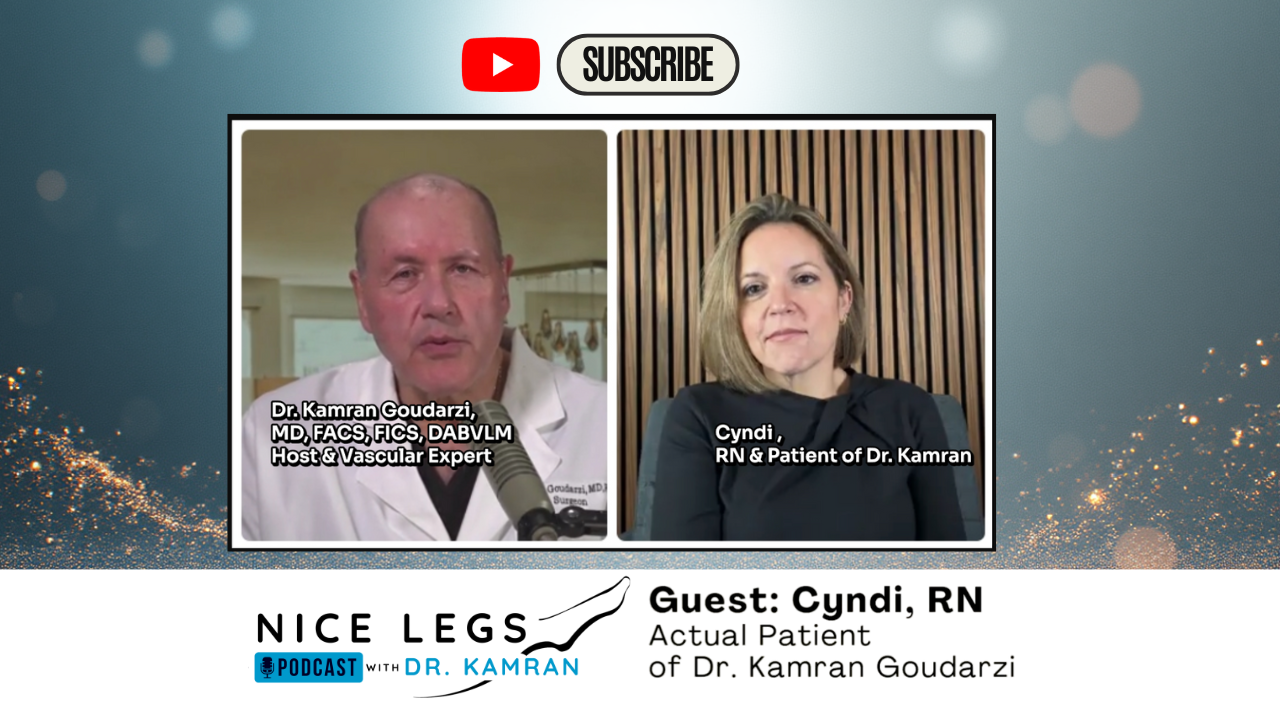
Dr. Kamran (00:00)
Now you, having experienced it, know what it was, and confirmed that some of your symptoms were clearly vein related, what would be your recommendation to those who are on the fence and not sure what they should do with their symptoms?
Cyndi (00:14)
If you’re feeling like questions aren’t being answered, keep pushing. You need to find the answers. And there you are doing something to better yourself in one, five, 10, 15 years.
Dr. Kamran (00:42)
And are you getting more, I call it miles per gallon out of your leg. Do you find you can walk further, you can do more, legs don’t tire out as much? Yeah, so.
Cyndi (00:48)
⁓ 100%. Absolutely.
Yeah. I mean, again, having three dogs keeps us pretty busy. throughout the day, even when I’m off, it’s constant going up, going down, getting up.
So moving now has been much easier. I will say that even after the procedures, this is probably nurse specific, clinician specific, I’ll say, any healthcare worker, we tend to not want to read discharge summary instructions or anything like that. Because we know, but absolutely need to move, especially the day of the procedure. You need to really be able to, and I felt it’s going to be strange to say, because you think that during the procedure you’re putting some…
some fluid in and the fluid has to go somewhere, you’d think you would feel more swollen. I felt almost relief the day as the day progressed of the procedure, each vein. And I don’t know if maybe it was in my head and knowing that this is what I was doing to help myself, but in my legs, it definitely, I have felt relief from day one and it just keeps getting better.
Dr. Kamran (01:51)
One of my patients I remember quite a few years ago said, Doc, I always walk five miles every morning, and then I knew I’d reached my limit. said, but now I feel I can go another mile. And that’s because we know that perfusion does improve. Circulation takes two ends. Blood has got to get there, and then blood’s got to get out. If it doesn’t get out, then you’re running into congestion. So I’ve noticed this. When the circulation improves, sometimes they feel they can
stand longer, they can walk more. Not everybody gets this. Again, I’m just trying to talk in generality. Do you feel that your legs don’t tire out as much and you can walk further, you can do more, you can bike longer or not yet?
Cyndi (02:35)
Sure, yeah, I do feel that they’re not as heavy, which definitely helps the movement more. So it’s not as much of a chore to move quicker, to get up faster, to get acclimated faster. And I’m not tired of doing those long durations of workouts, of biking longer, of biking and then walking.
definitely added onto my journey in being able to help my cardiovascular system. So it’s been definitely a huge piece to that puzzle.
Dr. Kamran (03:10)
you said you have animals and when you have those large veins around the ankle, you’re right. All it takes is a scratch. Sometimes people use a razor to shave their legs and those veins when they bleed, really bleed. I just had a gentleman who came here, one of those veins busted. He actually worked in a ⁓ butcher shop. So you can imagine a butcher shop.
So the guy goes up an urgent care and they just wrapped it up. By the time he got home was bleeding and he went back in. Then this time he went to the hospital and they actually put a bunch of really big stitches in his leg and he was still bleeding and eventually he came to the office several thousand dollars later and we had to go ahead and of course do what was necessary, we just closed the pipe. You can’t stitch a
Dr. Kamran (04:01)
a vein which is busted, it just keeps on leaking. And then you got a little wound infection from where they stitched it. So ⁓ sometimes those veins rupture simultaneously. If you have animals, cats, dogs, they can scratch you. Dogs like to jump on you and they can bleed. I had a patient who was actually a forester. She was also on blood thinners because she had irregular heartbeats. So she would say she would literally wrap her legs with cloth because she was worried if it was in the middle of the forest.
And there was, ⁓ if she ever ruptured that leg, nobody would dare to save her, she would die. Obviously it was very important, we wanna close those veins and she was very thankful to be able to get out there. So, know, veins do rupture, people don’t realize that and question I had for you, traveling. Did you notice when you were on a long flight your ankles were swelling up more than usual?
Cyndi (04:53)
Yes, and we were in the, moved from New York to here. So we did 10, 12, sometimes because of traffic, 15 hour drives down from New York. And by the time we would hit Virginia, I had to have my foot either extended in the back up on pillows or up, you know, intermittently throughout the ride. And by the time we got out of the car, was so, for lack of a better word, uncomfortable.
I don’t like to use the painful, but it was so uncomfortable to walk with the tenderness and the weight and that just feeling like it really like it was there’s the pressure inside was there’s nowhere else for it to go. I could tell from the really severe like varicose veins that I had when I was really swollen, they were very much protruding more. And it was so uncomfortable. It was.
uncomfortable because I knew it was happening. It was uncomfortable because I didn’t want to show my legs. I had over my leg, whatever covering was over my leg, pants, jeans, scrubs There was no more stretch gift. Nothing left.
Dr. Kamran (05:56)
never forget one day you came to the office, you said, my husband looked at my ankle and said, my God, your ankle looks really good. The swelling has gone away. Do remember? You told me that. So we could just like to expand on that and tell me exactly what.
Cyndi (06:07)
I do. Yep.
Dr. Kamran (06:13)
because husbands are usually very objective, usually.
Cyndi (06:16)
That’s true. Yes. He knows that I
was, and I have been always very self-conscious of my legs and my ankles, anything from the knee down. I would never wear, you know, skirts or dresses or, you know, going to gatherings that weren’t, you know, covering my entire leg. This summer, I, we went shopping. I wore, I bought like a skort set or something. And he said, I’ve never seen you.
be confident like this, but, and have you noticed, babe, you have an ankle to your right side? And I said, you’re right, I do. And since then now, it’s every day. we just recently went to New York for a wedding. I did not wear a long flowy dress, so wore like a dress that went to my mid calf. And I was very confident because I had an ankle, which is something I haven’t had in, I feel like 10 years. So, and was very confident in doing so. So that is definitely.
Dr. Kamran (06:48)
you
Cyndi (07:12)
testament to what you do, so thank you.
Dr. Kamran (07:15)
to you, because we are just a tool, you know, instrument. My biggest concern being a general vascular surgeon, being a surgeon for very, very many years, honestly I never, tell people I’ve never done so little and achieved so much, because it is really pretty straightforward. It’s just a technology. It’s a very smart way of doing things. And to be able to do this with minimal discomfort, local, in the office, and to be able to make a change in people’s lives, I think,
to me is extremely satisfying. I know as a nurse, we all get tremendous satisfaction when you’re doing your 18 hour days, you’re not thinking how much money you make or why you went to lifestyle. You look back at the end of the day and realize what you did for so many patients. And that’s what makes us feel good about ourselves. Just to be able to make a difference to another colleague like yourself, to be able to feel so much better and feel more confident about your legs, I think that’s wonderful.
So what would be your advice to average person in the street who ⁓ has been having some of those symptoms? What would be your recommendation? I think knowledge is a strength, right? Maybe Google your symptoms or, you know, go and see somebody who knows about veins.
So I think a lot of times, unfortunately, most physicians, when they finish medical school, they weren’t told about these things. So now you, having experienced it, know what it was, and confirmed that some of your symptoms were clearly vein related, what would be your recommendation to ⁓ people who are on the fence and not sure what they should do with their symptoms?
Cyndi (08:55)
I would say to your point is definitely doing your research and not just stopping. As a nurse, I always like to advocate for my patients and really put the strength back in them. You know your body better than I do, better than your physician does. So if you’re feeling like your questions aren’t being answered, keep pushing. You need to find the answers. And there is help. It’s not a one-stop
It is a commitment, but in the end, just like with anything, surgery sometimes is a quick fix. You get your appendix out and the next day you’re home. But it is after that, making sure that you are progressively getting better. It is the same thing for your legs. It’s the same thing for this procedure. Making sure that you are doing the research for your provider, looking to see what your experience, other patients’ experiences are, and knowing that in the end you are doing something to.
better yourself in one, five, 10, 15 years.
Dr. Kamran (09:50)
call it metamorphosis. You’re going to continue to see improvement in your legs, the shape, in the feel, and it kind of levels off. And then the rest of it is maintenance therapy. There’s one lesson I’ve learned. Always follow your patients on a regular basis.
There are surgeons, and this is more art than science, there’s nothing wrong with what they do, but they believe they should just treat one vein or two veins and leave the rest behind. One lesson I’ve learned, trust me, they will bypass what you have and it will undo what you’ve done.
Cyndi (10:21)
Mm-hmm.
Dr. Kamran (10:21)
And so I’ve noticed do the best that you can. So when you leave your patient, when they leave your office, they leave with a whole new set of legs. Again, thank you so much Cyndi for your don’t try to find a reason for all your aches and pains and then live with it because there might be something that can be done to really improve your quality of life and this is what it’s all about.
Cyndi (10:42)
Mm-hmm.
I agree. Thank you.
Dr. Kamran (10:45)
Thank you so much.